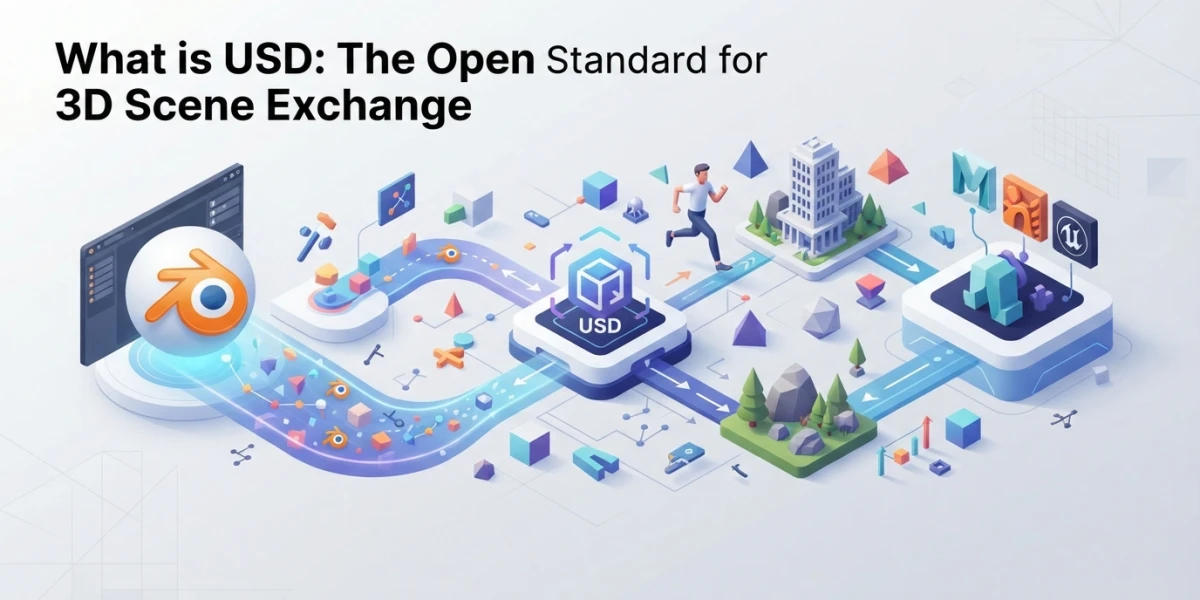
Image generated with AI
What Is USD: The Open Standard for 3D Scene Interchange

Diego Cortés
Author
If you use Blender, Maya or Unreal, you have probably seen the USD label in import and export menus; behind those three letters is the format Pixar created to compose 3D scenes and that now powers half the industry.
What is USD and where does it come from
Born at Pixar
USD (Universal Scene Description) is a framework for exchanging 3D graphics data that Pixar developed for its own productions and later released as open source software. Its goal is not just moving meshes between programs, as FBX or OBJ do, but letting complete scenes made of many assets travel between tools without losing information.
OpenUSD
OpenUSD is the open version of that framework, maintained by the community and backed by the industry. It was the first publicly available software to tackle robust, scalable interchange of composed 3D scenes: you can share anything from a single asset to a full animation with multiple sources and layers.
How it works: layers, prims and composition
Layers and opinions
In USD the scene is organized into layers that contribute "opinions" about the data, and the final result is the composition of all of them. It is the same principle as a non-destructive adjustment: each layer modifies part of the scene and the result is computed when they are composed, without destroying the original work.
References and variants
An asset can be referenced by many scenes, like a linked instance: if you change the original asset, every reference updates. Variants let you swap versions of the same element, for example a car with and without damage, without duplicating geometry.
Non-destructive editing and collaboration
Because each artist can work on their own layer, multiple teams edit the same scene in parallel without stepping on each other. That is why it was born in a film studio: production pipelines need large-scale collaboration without bottlenecks.
Why it matters in 2026
The Alliance for OpenUSD
In August 2023, Pixar, Adobe, Apple, Autodesk and NVIDIA founded the Alliance for OpenUSD to standardize and accelerate adoption of the format; soon after, Epic Games, Foundry, SideFX and Unity joined as general members. The joint backing of the major 3D software companies made USD the natural candidate for an industry standard.
Real interoperability
Blender, Maya, Houdini, Unreal and other tools import and export USD natively. That enables mixed pipelines —modeling in Blender, animating in Maya, composing in Unreal— without the destructive conversions imposed by classic formats.
Beyond film
USD is the foundation of NVIDIA Omniverse and increasingly of industrial design, simulation and generative 3D AI workflows: any system that needs to exchange complex scenes between applications ends up looking at USD.
USD in Blender and Maya
Native support in Blender
Blender has included USD import and export for several versions, with animation support on most properties, and every release improves the integration. Exporting a simple scene and reimporting it is the fastest way to understand what the format preserves.
USD in Maya and Omniverse
Maya works with USD data natively and Omniverse uses it as its central language to connect applications. In practice, learning the basics of USD opens the door to pipelines that cross tools without friction.
First practical steps
Exporting a simple scene
In Blender, go to File → Export → USD and export a scene with a couple of objects and a simple animation; when you reimport it you will see that the hierarchy and transforms are preserved. It is a five-minute experiment that teaches more than any definition.
Resources to keep learning
The official OpenUSD documentation and the Pixar and NVIDIA Omniverse pages are the starting point to go deeper; the curated video tutorials on this platform about pipelines and interoperability help you see it in a real context.
Conclusion
USD is not a fad: it is the open standard unifying 3D scene interchange across the industry. Knowing its basic concepts —layers, references and composition— prepares any artist for today's pipeline.