Best GPU for 3D Rendering in 2026: What to Buy on Every Budget

Diego Cortés
Author
Choosing a GPU for 3D rendering in 2026 is no longer a race of clock speeds: VRAM decides which scenes you can open and how many hours you spend waiting on renders. This guide walks through every budget tier using data from Blender OpenData, plus a key warning: street prices are currently running far above MSRP.
First Things First: VRAM Rules 3D Rendering
In 3D rendering, a graphics card is not chasing frames per second but memory and compute to resolve light. The golden rule of 2026 is simple: buy the GPU with the most VRAM your budget allows, and only then compare performance per dollar.
Why 8 GB Falls Short and 12-16 GB Is the Sweet Spot
Current production scenes —4K textures, geometry nodes, simulations— easily exceed 8 GB. At that capacity, the system falls back to system memory and rendering slows down. In 2026, 12 GB is a reasonable minimum and 16 GB the sweet spot for most artists.
Heavy Scenes and the New Cycles 5.2 Texture Cache
The new texture cache in Cycles 5.2 offloads textures to disk when a scene does not fit in VRAM, cutting the memory required in projects like the Bistro scene at the cost of a small increase in render time.
How to Read Benchmarks: Blender OpenData
OptiX, CUDA, HIP and oneAPI: Every Brand Has Its Own API
NVIDIA accelerates Cycles with OptiX and CUDA, AMD with HIP and Intel with oneAPI. OptiX remains the most mature acceleration path, though HIP has closed the gap in recent Blender releases.
The RTX 5090 Leads the Charts
The RTX 5090 with 32 GB of GDDR7 has topped OpenData since early 2025. For everyone else, the Blender 4.4 leaderboard lets you compare the RX 9060 XT and RX 9070 XT, the RTX 5060 Ti and the RTX 5070 Ti under identical conditions.
Entry-Level Budget (Up to ~$350)
The Intel Arc B580 with 12 GB is the budget pick against the RTX 4060 and RX 7600 XT: more memory for less money. The 8 GB RX 9060 XT sits around its $299 MSRP and handles light scenes and previews, though its limited VRAM leaves little room for large projects.
Mid-Range ($350-$650)
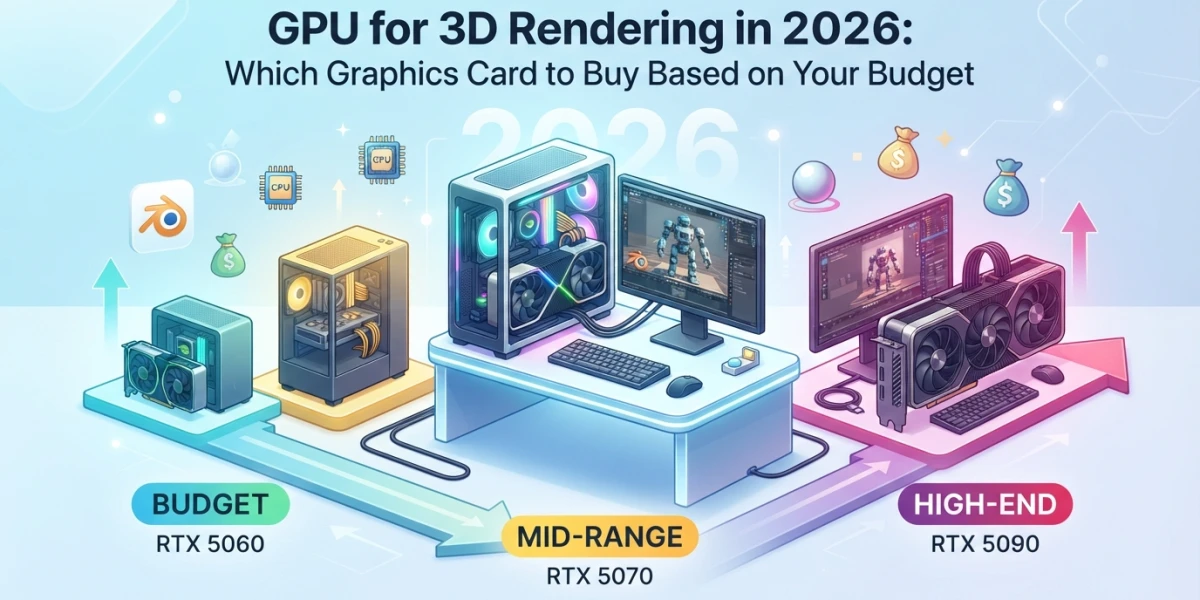
The 16 GB RTX 5060 Ti, at a $429 MSRP, is the most repeated recommendation for Blender in 2026: OptiX combined with enough VRAM for serious scenes. Its street price peaked around $650 and has been normalizing. The 16 GB RX 9060 XT is hailed as the price-to-performance queen of summer 2026, and a real alternative to NVIDIA if you do not depend on OptiX. The RTX 5070, with 12 GB and a $549 MSRP, renders faster but again falls short on memory.
High-End and Enthusiast ($650-$2,000+)
The RTX 5070 Ti ($749) and the 16 GB RX 9070 XT are the tier where production rendering gets comfortable. Above them, the 16 GB RTX 5080 ($999) delivers a clear performance jump. For enormous scenes, the 32 GB RTX 5090 is the definitive card: it leads OpenData and handles projects that once demanded render-farm solutions.
Watch Out in 2026: MSRP vs Street Prices
In 2026, street prices run far above MSRP: the RTX 5070 Ti has been seen around $1,000 (+34%), the RTX 5080 around $1,360 (+36%), and the 8 GB RX 9060 XT jumped from $299 to roughly $420. Tom's Hardware describes market prices as "stratospheric". Treat MSRP as a theoretical reference and compare real prices in your local market.
Conclusion
The best GPU for 3D rendering in 2026 is chosen with two data points —VRAM and benchmark per dollar— with your eyes open to street prices. The 16 GB RTX 5060 Ti or RX 9060 XT is the sweet spot if you are starting from scratch; the RTX 5090 is waiting for those who truly need it. And remember, hardware is only half the story: our platform curates video tutorials to help you get the most out of your render setup.