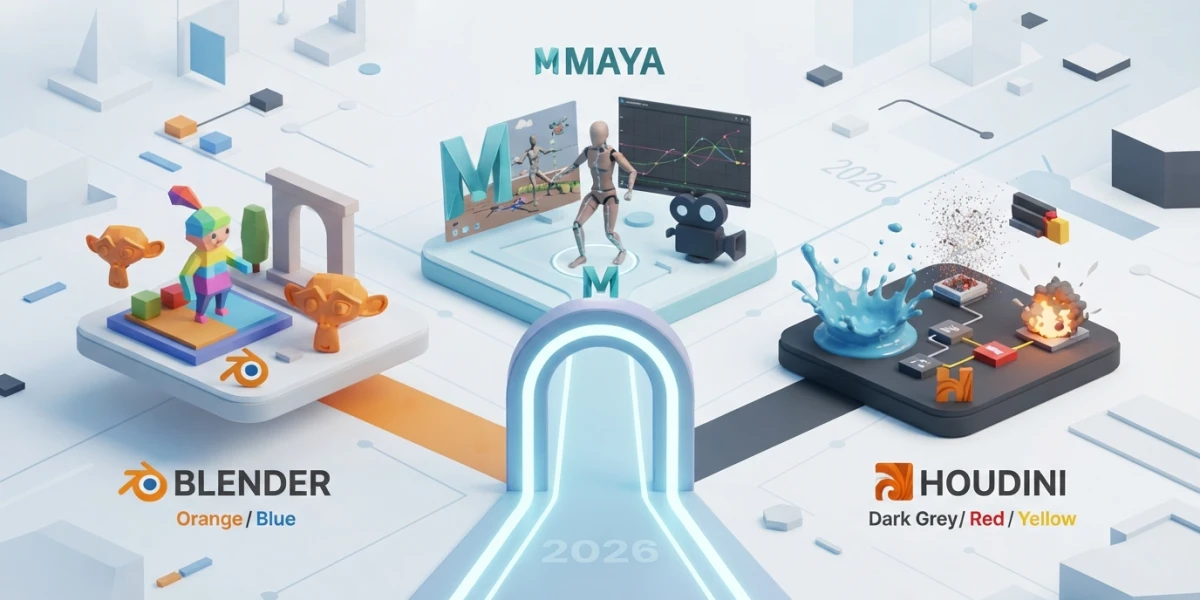
Blender vs Maya vs Houdini in 2026: Which One Should You Choose?

Diego Cortés
Author
Blender vs Maya vs Houdini is the most repeated debate among people getting into 3D, and in 2026 it is back on the table because all three programs shipped major releases in the same year. Blender 5.2 LTS arrived on July 14, Maya 2027 on March 25, and Houdini 22.0 on July 15. Each release reinforces the territory its developer already owned: accessibility and modeling, production animation, and procedural effects. Choosing one depends on your goal and your budget, and here are the facts to decide.
Three Major Releases in 2026
That all three tools updated within a single release cycle is no coincidence: the CGI industry moves fast and the three vendors compete for the same artists. Blender 5.2 LTS is the foundation's long-term support version, with maintenance guaranteed until July 2028. Maya 2027 introduces AI-assisted tools and improvements across every production area. Houdini 22.0 strengthens its fully procedural pipeline. With all three versions fresh, the 2026 comparison is the fairest in years.
Blender: The Free All-Rounder
Blender remains the only completely free and open source option on this list, funded by the Blender Foundation and backed by AMD, Apple, Intel, NVIDIA and Qualcomm. Its historic strength is modeling and ecosystem: a huge community, thousands of add-ons and an extremely fast development cycle.
Version 5.2 adds node-driven physics, with a new experimental XPBD Solver node for simulating cloth, hair and skin, plus remote access to asset libraries and core libraries updated to the VFX 2026 platform. It is the tool with the best cost-to-capability ratio, especially for beginners.
Maya: The Studio Animation Standard
Maya has been the primary animation tool in film and television for more than two decades. Its strength is not novelty but maturity: studio pipelines, rigging and character animation with a workflow proven across hundreds of productions.
Maya 2027, released on March 25, focuses on AI-powered tools and improvements in 3D modeling, look development, rigging, animation, simulation and rendering. If your goal is to work at an animation studio or on AAA games, it is still the software most job listings ask for.
Houdini: The King of Procedural FX
Houdini is the de facto standard for visual effects: fluids, destruction, smoke and simulation. Its philosophy is fully procedural: everything is a node network you can reuse and parameterize, which makes it ideal for large-scale VFX pipelines.
Houdini 22.0, released on July 15, improves the workflow across every production stage and keeps the tool among the leading VFX options in industry comparisons. It has the steepest learning curve of the three, but it is also the most requested tool in effects studios.
Price Comparison in 2026
Blender: USD 0
Free and open source, with no commercial restrictions. The most economical option, no debate.
Maya: Around USD 1,875 per year
The annual plan costs roughly 1,875 dollars, though students get it free while studying. It is the usual investment when a studio already runs an Autodesk pipeline.
Houdini: From USD 299 to USD 3,195 per year
Houdini Indie costs 299 dollars per year per workstation and includes two Karma licenses, its rendering engine. Annual node-locked rentals range from 1,340 dollars (Core) to 3,195 dollars (FX), with Houdini Engine at 499. The Apprentice version is free for non-commercial use. Prices can change: always check the official SideFX store.
Which One Should You Choose in 2026?
The answer depends more on your profile than on the software itself:
- Student or indie artist: Blender. Free, with a massive community and everything you need to learn and publish.
- Studio animation and rigging: Maya. It is what most film and TV job listings ask for, and its free student license lets you practice at no cost.
- FX and VFX: Houdini. If you want to work in effects, it is the tool VFX studios look for, and Apprentice lets you learn for free.
Conclusion
Blender vs Maya vs Houdini has no absolute winner: it has three winners depending on your goal. Blender leads in accessibility and modeling, Maya in production animation, and Houdini in procedural effects. The smartest move in 2026 is to start free with Blender or with the student versions of Maya and Houdini, then decide after hours of real practice. And when you want to see these tools in action, the video tutorials on CGI Academy Hub walk you through the complete workflow step by step.